Friday, February 26, 2010

Haymarket was a creek

Journal 3, Feb 26, 2010

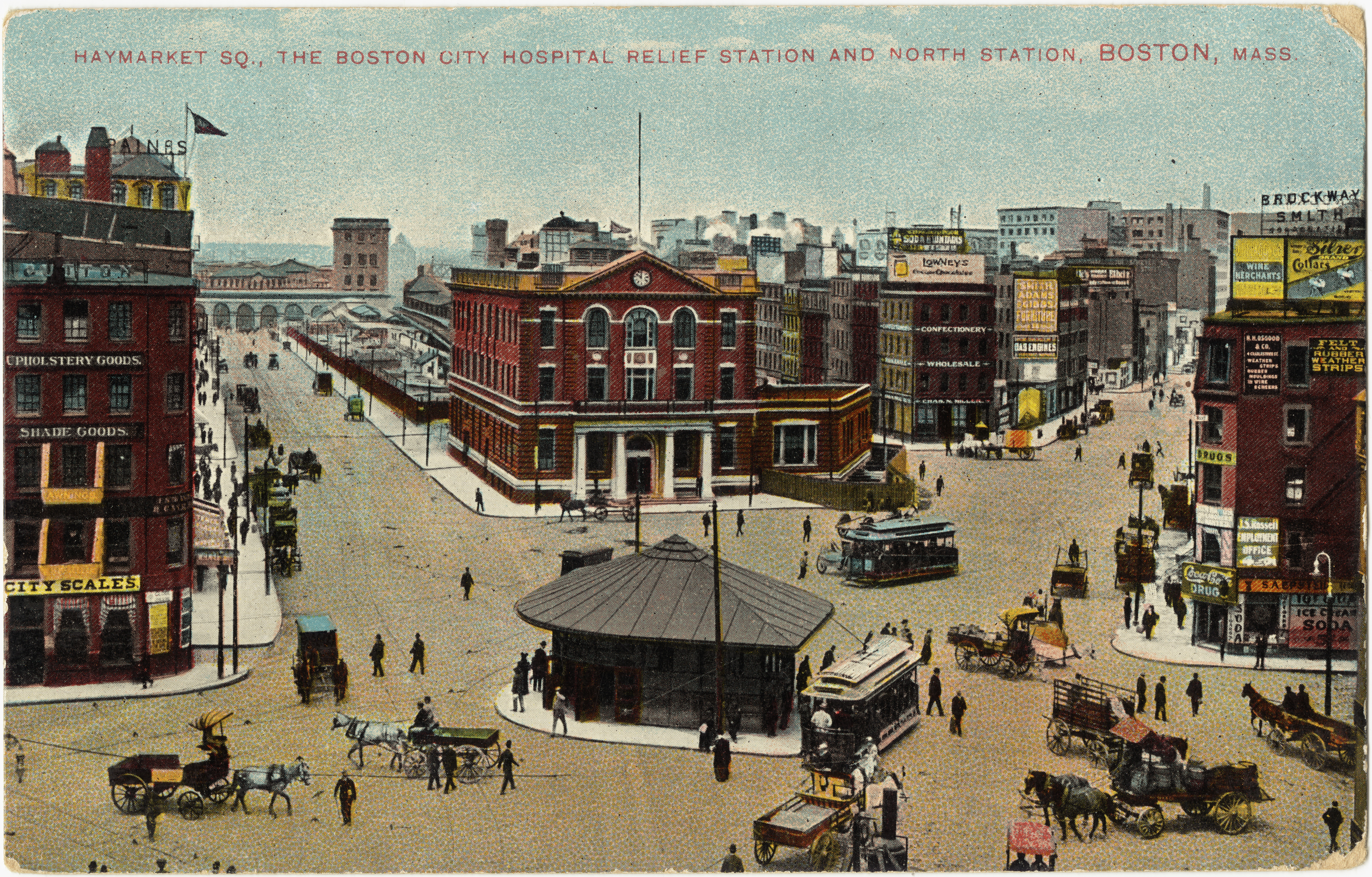
At turn of the 20th century Haymarket Square looked like this.

Now there is a massive row of highways that has been laid on top and the eastern (i honestly don't know which direction this is facing but i will find out when I visit) portion of the square is covered by a mass of pavement - Highway 1 and I-93 among others. Comparing the current map to this picture it seems that the square was originally located on one of the two eastern corners of what is today the Haymarket T Station.


Haymarket was opened as an open air market in 1830 according to this 2005 article. However, I did find a book in Rotch library that was written in 1970 and claims Haymarket has been open in some form or another for 300 years, leaving us around 1670 (Snyder, 1970). To be fair, the book is more of a book of poems, quotes, and pictures, and less of a historical reference. Given Boston was founded in late 1630, this is possible but there is quite a difference between those two starting dates. Until I learn more I will assume that a market of some form has long been present in the general vicinity of Boston.


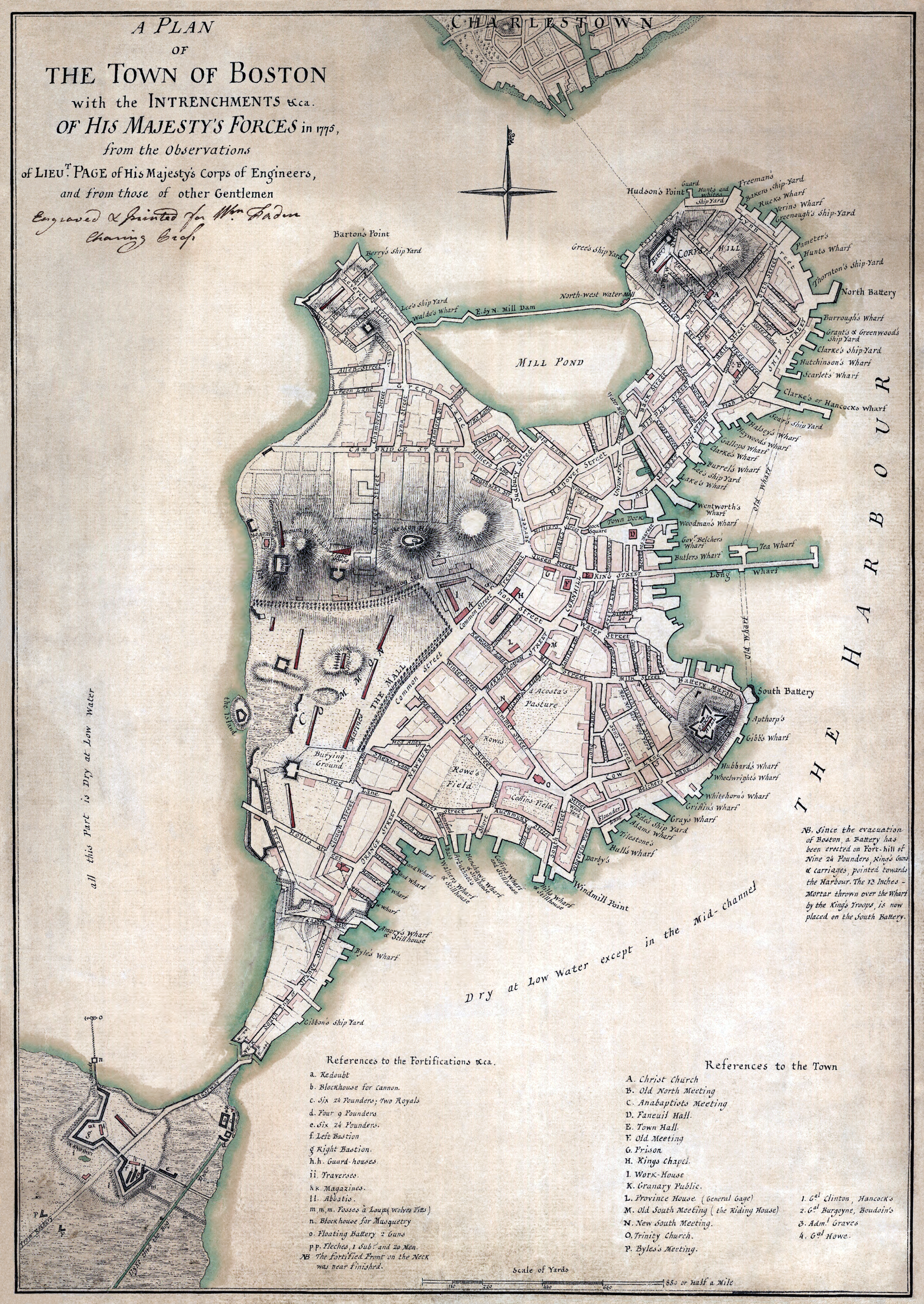
More on the topic of nature, I am very interested in trying to map out exactly where my site is located relative to old maps before the land was filled. I know it is near the southeastern tip of Mill Pond, and it is quite likely that part of my site is in the water, so I spent some time trying to orient myself on this 1775 map. One thing that seems quite clear - oh wait! check out this map! By using this map from 1871 (note that Mill Pond is filled in) and combining all three aforementioned maps (including google maps), I was able to answer most all of my questions for the location of my site. It turns out Haymarket Square was located just outside the southeastern corner of what is today Haymarket T Stop. Between 1775 and 1871 a small creek called Mill Creek (with a Water Mill that seems to have been set up to run off of tides with outflow controlled by the dammed Mill Pond.


The three streets that were present on all the maps are: Union Street, Hanover Street, and Cross Street. Since Hanover intersects with Cross and Union this was the best clue for finding the exact location of my site near my site this was helpful as a reference. Looking closely, and going back and forth between the maps, I can now tell precisely where my site is. To illustrate this I made a quick sketch of my site (in red) overlayed upon the 1775 map. Note that part of my site is indeed in Mill Pond. The blue X marks a close estimate of the location of Haymarket Square, and the two blue lines farther south mark the main two streets of Haymarket. As you can see, Blackstone Street was in fact Mill Creek at one time. There should be signs of this at my site. It is clear, that Blackstone was added when Mill Pond was filled in the 1800's. Possibly it was buried similar to the creek in Dudley Square? Note further that there is a small inlet of green on the map below that represents an inlet or creek branching off of Mill Creek. Along this location today we find a street called none other than Creek Street.


I would like to find this map but bigger so I will look for that in the archives. One final note to conclude: It seems that my dating question has in part been answered as well since the Mill Pond filling began in 1807 and finished in mid-1800's. Therefore Haymarket could have existed 300 years ago in some fashion, possibly even along the creek, but certainly not in any fashion very similar to today.




Tuesday, February 23, 2010

2 - Zoning

Feb. 19, 2010
Journal 2

Zoning is an interesting concept, but its forms of application and ramifications are defining the frontiers of the world today. Grady Clay posits that since the 1880's the American frontier has shifted from East-West settlements to Urban-Suburb fronts. And he has cartoons to prove it (p. 77).

Did tribal communities in America zone? Of course they set aside land for stationary activities such as farming and long-term shelter, so I suppose they were "zoning". I only recently became cognizant of the extent to which it defines everyone's life. It has to, right? What with residential vs public vs corporate landuse. Working with long-term development NGOs in Peru, one of the main focuses was on incorporating land titles and rural zoning: "Ordenacion Territorial (OT)". OT sounds like a supremely taxing and paternalistic activity to dedicate one's life to - at least in a place where the people who live on the land see no need for land zoning, and feel threatened by wealthy outsiders that visit them threatening to move houses and farmlands for roads. In exchange the people will receive faster transport of goods to the urban markets, new roads, and construction jobs.

One employee of GTZ, a German governmental developmental agency, named Victor was especially engrossed in OT. He was on a national committee that met monthly to discuss the once and future zoning of Peru. After accompanying a few GTZ employees on a trip out to the foothills of the Andes, we returned to the office and Victor began asking about my perceptions of the land use in the rural areas we had just been. The people there ate green pods and potatoes without flavor of any kind. This was what kept through the cold winter months. I hadn't thought about zoning, nor had I thought about politics. I felt like I had come back from the frontier, or as they called it "El Campo".

I don't know America well, but I believe him that the frontier of today is the suburbs - from a national perspective. But, we live in a global age, where America's market is internationally driven and spending by individuals, corporations, and governments is based on trends in countries around the world. Maybe a more appropriate question of today is: what is the world's frontier?

I would argue that the world still has a very real frontier, but it is about to disappear. My generation may be one of the last to ever view the Amazon as an untouched jungle. With discovery and of oil, 80% of the Amazon has already been zoned and contracted out to transnational oil consortiums. Uncontacted indigenous lands and fragile ecosystem zoning is being disregarded in light of the economic trade-off. With subsidies from the American government, and the American International Development Bank, Hunt Oil among many other large oil firms are "quietly" pumping and spilling oil to the coast and up to California. Unbeknown to the average American, he is in fact still expanding into the frontier. It may not be American territory, but it has become American turf.

When it comes to thinking about zoning, it turns out that Haymarket, aka Parcel 9, is in for layers of zoning. According to a December, 2009 article plans are moving forward for keeping Blackstone St. as a ground market and building offices or possibly residential apartments on top. One of the likely plans for offices is funded by the Rockefeller family, which happens to already own other pockets of prime Boston real estate. The other plan under consideration is for a Museum that will be subsidized heavily by a public subsidy.

1 - Mobs

Adam Talsma
Feb. 12, 2010
Journal 1

"All gatherings are not potential mobs, alll gleaming waters are not to be scrutinized for oil slicks, nor all forests penetrated merely for proof of corporate clear-cutting. There are pleasures as well as crimes to be uncovered, distinction to be made, and prospects to be explored in clear detail, and understood." (Clay, p. 32)

The quote above would have been useful for a Fulbright proposal I made (and didn't get) to travel to the Amazon in Peru to do a video project with communities. I didn't realize that the Fulbright was federally manipulated.

Let's be honest, you and I. Whispers only, because I don't know about other places. At MIT, though, life is easy. Playing engineer student is hard at first. Then, suddenly, when your head settles down, you realize that we are being trained to be highly paid calculators, managers, and little more. What really matters is somewhere much deeper. But how do you find what is deeper? How do you even find the path headed that way? These are thoughts that I have all the time, and it seems that sociologists might have some answers.

Something related to Grady Clay's honest questioning of the genesis of city form and urban flows in Close-Up really hit home for me. For the most part the first 60 pages seem a bit wishy-washy. He says surpisingly little (though it flows well) in the beginning, but he is honest about not offering anything revolutionary, just different ways to use your eyes to generate first-hand information about a place. I think he is actually describing a set of starting points for applying the Socratic Method to analyzing cities. And that makes sense. I also liked the diagrams a lot. His quick sketches to describe "Breaks" inspired me. In addition, I liked the analogy that the old concept of chasity has been structurally undermined by the pill, so the old cocept of centrality has been undercut by everyman's access to space by movement (commuting, vacationing, long-range, visiting, etc).

Since I am under the impression that I am meant to discuss my site, I must say that I am having some issues knowing what metrics to use when choosing a project. From an engineering design perspective the most important step is identifying criteria by which to guide every other step of the design process. The steps for choosing my site are simply too wide open. I have thought about choosing an are near where I live or have lived which means around Union Square in Cambridge or near Kenmore Square in Boston. Kenmore Square seems too large, otherwise I would take it. Besides right next to it lives a highway and Fenway so without taking those into account it seems impossible to give a good representation of Kenmore. Union Square seems too disconnected and uninteresting. Both of these are very accessible to me.

What do you think?